In the Scottish Parliament, few issues are as personal and urgent as access to life-changing diabetes technology. Managing Type 1 diabetes (T1D) is a relentless, daily challenge, requiring constant monitoring and insulin adjustments. Without advanced technology like hybrid closed loop (HCL) systems—devices that automate insulin delivery—people with T1D face serious health risks, from seizures to heart disease and kidney failure.
Yet, across Scotland, long waiting times and restrictive policies mean that many are denied access to this vital technology. Some wait over five years for an insulin pump, while others are given outdated systems that fail to meet their needs. Families are left struggling, forced to monitor glucose levels manually when modern tools could ease their burden.
Real stories, like that of Jane*, highlight the crisis. She endures sleepless nights, constant blood sugar crashes, and up to 16 finger pricks a day—simply because the technology that could transform her life is deemed “too expensive.” But the real cost comes later: the NHS spends 10% of its budget treating preventable complications of diabetes.
Access to the best available care should not depend on postcode or income. Scotland must do better. Investing in diabetes technology now means healthier lives, fewer complications, and a healthcare system that truly supports those with T1D.
*Name changed for privacy.
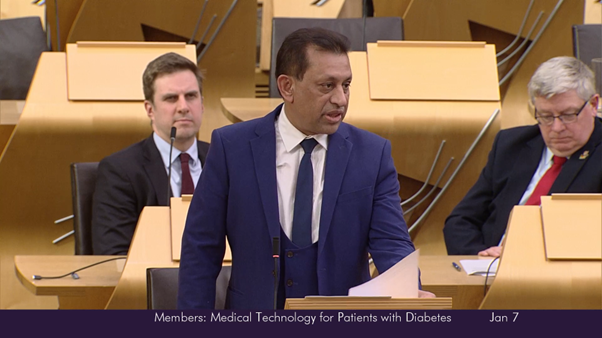
Honoured to have led the first Member’s Business of 2025, speaking on the importance of access to diabetes technology. Patients should always come before profits.
It is deeply concerning that financial constraints are dictating clinical decisions in diabetes care, leaving patients without the vital treatments they need. Investing in early intervention, regular health checks, and life-saving technology is not just the right thing to do—it is also the most cost-effective approach in the long run.
Read more: The NHS must prioritise patient well-being over short-term budget cuts. I stand with diabetes patients in calling for urgent reform to ensure access to the care they deserve.
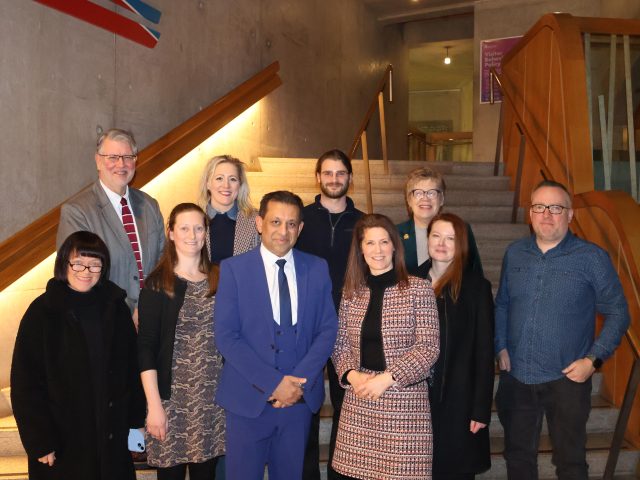
What constituents have had to say before the Member’s Business:
“I have been Type 1 for over 20 years. I fought for access to an insulin pump for 5 years. I received a call to say I was at the top of the list the day my story was published in the paper. I am now being denied a choice of CGM to enable me to have a HCL. I am not allowed Dexcom because it is considered “too expensive” I can only have Libre. For safety I cannot use this. Previously Libre would tell me I’m 23 but the finger prick was 9. It could give me too much insulin and could kill me.”
- Shelley Murray, Type 1 diabetic and Lothian constituent.
“We know that diabetes teams across Scotland want to do the best for their patients but are restricted by administrative and budgetary constraints.
A toolkit to assist decision-making is published by NHS Health Improvement Scotland and the Scottish Intercollegiate Guidelines Network (SIGN 170 – https://www.sign.ac.uk/our-guidelines/optimising-glycaemic-control-in-people-with-type-1-diabetes/), but may be disregarded with people being given equipment that does not meet their exact needs and may put them at risk.
This has got to improve. Patient safety has to come first.”
- Mary Moody, Chair of iPAG (Insulin Pump Awareness Group).
“While we welcome the additional £8.8 million that has been allocated for Type 1 Diabetes Technology, this money will only fund a small finite number of people for that year and future years. There is no long term plan to increase that spending to benefit a larger proportion of the 36,000+ people living with Type 1 Diabetes.”
- Paul Niven, Type 1 diabetic and online activist.
“We shouldn’t have to fight for the best possible care when we are struggling to manage our condition.”
- Lesley Ross, Type 1 diabetic and online activist.
“I’ve been managing my Type 1 diabetes via insulin pump therapy since 2009 and find it staggering that 16 years later we have a projected waitlist in Lothian of 1,200 patients waiting for an insulin pump by March 2025. Why has there been no forward planning by the Scottish Government to ensure there are sufficient funds for insulin pumps for those who’d like one?
Especially when diabetes technology took such a leap ten years ago with the introduction of NHSS-funded Flash Glucose Monitoring. And now we have even more advanced technology, Hybrid Closed Loop Systems where insulin pumps use Continuous Glucose Monitoring sensors which ‘speak’ to the insulin pump, enabling less user input, safer outcomes and improved quality of life. England and Wales have a plan for the next five years, should Scotland not have the same plan?
We should not have to be campaigning for something that is fundamental to our lifelong, good health and wellbeing.”
- Alison Templeton, Type 1 diabetic and member of iPAG.
“Parents, children, and people with additional support needs are being offered systems that I don’t consider to be safe because accountants are making clinical decisions.”
- Stephen Nixon, Type 1 diabetic and Lothian constituent.
For more of constituent’s voice: Media posts by Foysol Choudhury MBE MSP (@FoysolChoudhury) / X
